January 29, 2026
What are the chances?
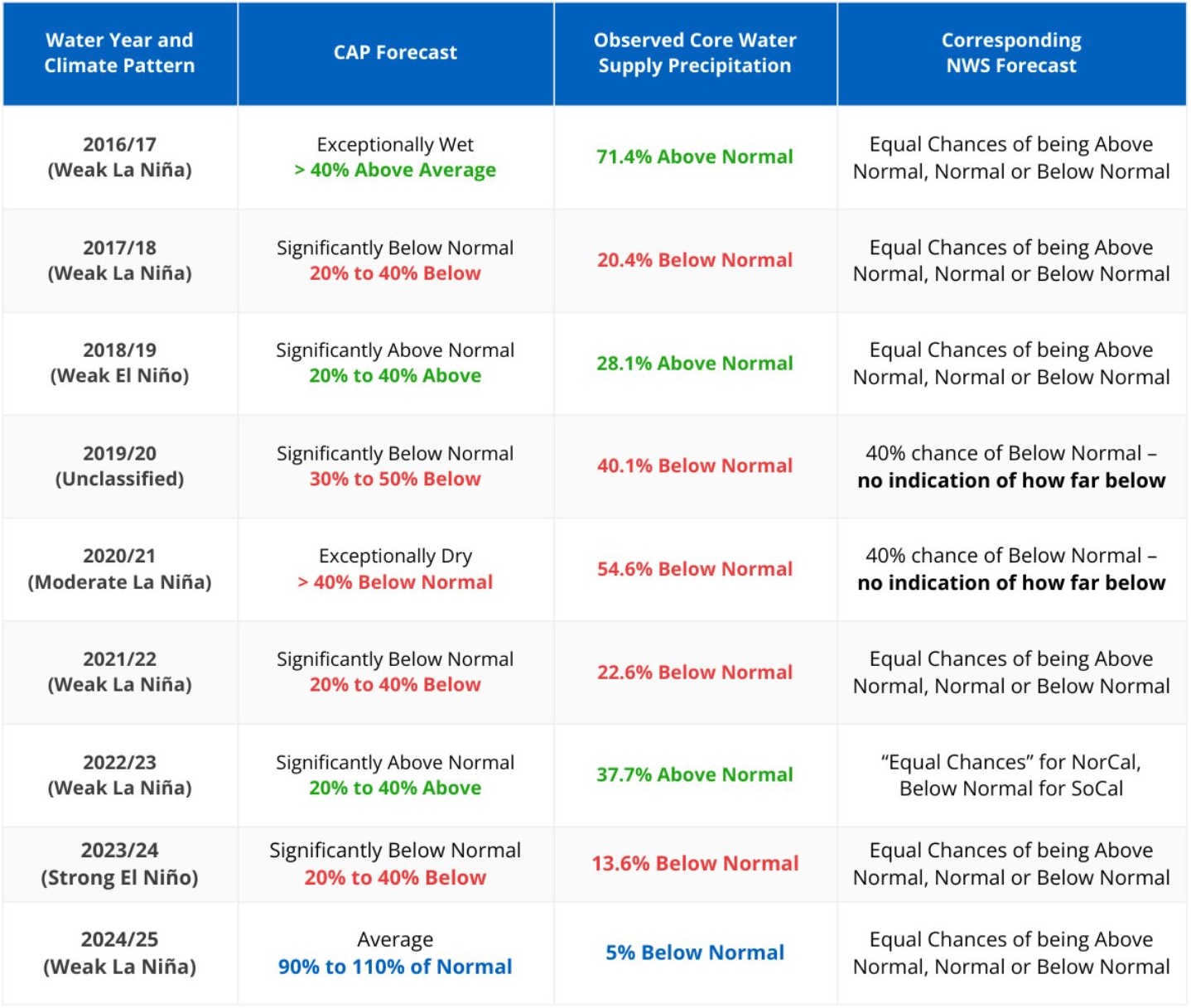
Early on, when we introduced the California Annual Precipitation (CAP) forecast, the response was often polite—and skeptical.
“Interesting, but come back when you have a 30-year track record.”
Or, “How do we know this isn’t just working by chance?”
It was a fair question.
Forecasting an entire water year before it begins is not a small claim. So, we focused on one thing: letting the forecast verify.
Each year, CAP issues a forecast for total water-year precipitation, expressed in 20% ranges relative to normal. There are seven mutually exclusive outcome ranges, or “buckets.”
Each year, the observed outcome has landed in the forecasted bucket.
Nine years. Nine verifications.
But we needed a longer record. Because our Weather Tools station network has a limited data history, we started to think outside the box. Would the model work in other locations with similar climate characteristics?
We applied the same forecasting framework to Australia, and then to Israel.
The result? The forecast verified in both locations, for every year tested.
Across California, Australia, and Israel, we now have 25 independent water years where the forecasted precipitation range matched reality.
If these forecasts were random guesses, the chance of choosing the correct range or “bucket” in any given year would be about 1 in 7. The probability of being correct 25 times in a row?
About 1 in 1.3 sextillion.
If CAP was correct by chance, we would have seen a miss long ago.
This does not mean the CAP forecast is perfect, or that it will never miss. But results like these tell us something important: the skill we are seeing is not accidental.
When the model performs consistently across geographies and years, it suggests that CAP is capturing something fundamental and groundbreaking. That possibility is now being explored through independent validation.
Early skepticism was reasonable.
After 25 independent verifications on three continents, the question is no longer whether CAP works by chance, but rather what this means for water management in California and beyond.