April 30, 2026
March was quiet April wasn’t

March brought the season to a near standstill. Across much of California, precipitation accumulation flattened during what can be one of the wetter months of the year.
Just How Dry Was March?
To put March in context, we look to the Department of Water Resource’s 8-, 5-, and 6-station indices, which track precipitation across the Northern Sierra, San Joaquin, and Tulare basins. Using a 30-year record, the March accumulation averages are 7.39”, 5.65”, and 4.19”, respectively.
In March 2026, those totals fell to just 0.09”, 0.01”, and 0.04”—the driest March on record across all three regions.
April Showers Changed the Story
With the turn of the calendar came a turn in the pattern. April was wet—but how wet?
In the Northern Sierra and San Joaquin regions, April ranks among the top five wettest Aprils in the past three decades, with totals exceeding roughly 85% of historical values. The Tulare Basin saw a more moderate rebound, with precipitation ranking above average but not extreme.
A Rare Late-Season Reversal
Taken together, the March–April transition represents one of the most pronounced late-season shifts in the historical record, as illustrated by the contrast in the images below.
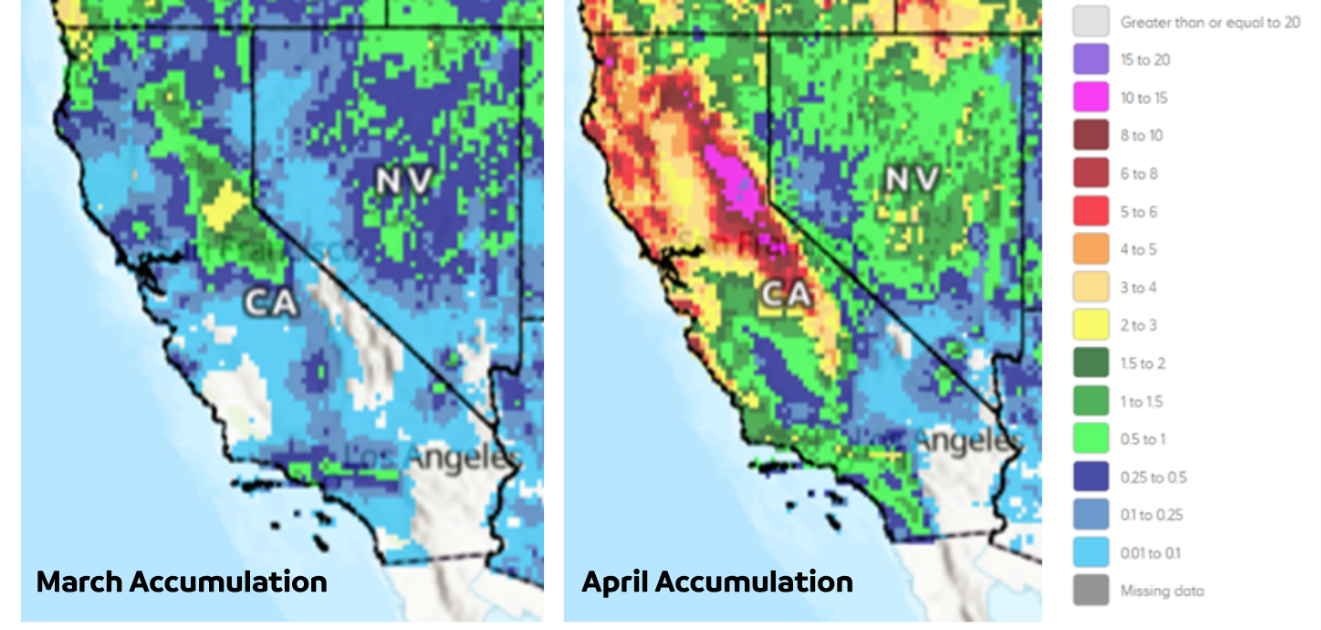
Source: NOAA National Water Prediction Service (NWPS), observed and forecast hydrologic conditions
Using the change in precipitation from March to April as a measure of late-season reversal, 2026 ranks as the largest increase in the 30-year record for both the Northern Sierra and San Joaquin regions, while the Tulare Basin recorded its second-largest increase on record.
California water years have been described in many ways. But “boring” is never one of them.
The sharp reversal from March to April highlights just how quickly conditions can change and how difficult it is to rely on in-season signals alone. Weather Tools addresses this challenge by providing a full water year outlook at the start of the season, helping water managers move from reacting to events to planning for outcomes. In a system defined by variability, reducing uncertainty early makes a difference.